YEAR:
2024

AWS
AWS
AWS
Flexible Area Models
Flexible Area Models
Flexible Area Models
about.
As AWS customers scale their cloud usage, managing and optimizing costs becomes increasingly complex—and increasingly critical. Many organizations struggle with unexpected spikes in their cloud bills, often discovering them only after the fact, when it’s too late to take corrective action. Customers have consistently expressed the need for a reliable, intelligent, and real-time cost monitoring tool that not only alerts them to anomalies but also provides clarity on what caused the issue and how to respond.
As AWS customers scale their cloud usage, managing and optimizing costs becomes increasingly complex—and increasingly critical. Many organizations struggle with unexpected spikes in their cloud bills, often discovering them only after the fact, when it’s too late to take corrective action. Customers have consistently expressed the need for a reliable, intelligent, and real-time cost monitoring tool that not only alerts them to anomalies but also provides clarity on what caused the issue and how to respond.
As AWS customers scale their cloud usage, managing and optimizing costs becomes increasingly complex—and increasingly critical. Many organizations struggle with unexpected spikes in their cloud bills, often discovering them only after the fact, when it’s too late to take corrective action. Customers have consistently expressed the need for a reliable, intelligent, and real-time cost monitoring tool that not only alerts them to anomalies but also provides clarity on what caused the issue and how to respond.
user pain point.
“We often don’t realize there’s a cost spike until the monthly bill arrives—by then, it’s too late to react.”
“It’s difficult to trace the root cause of unexpected charges across multiple teams and services.”
“Unplanned costs disrupt our budget forecasts and create friction between engineering and finance teams.”
“We often don’t realize there’s a cost spike until the monthly bill arrives—by then, it’s too late to react.”
“It’s difficult to trace the root cause of unexpected charges across multiple teams and services.”
“Unplanned costs disrupt our budget forecasts and create friction between engineering and finance teams.”
“We often don’t realize there’s a cost spike until the monthly bill arrives—by then, it’s too late to react.”
“It’s difficult to trace the root cause of unexpected charges across multiple teams and services.”
“Unplanned costs disrupt our budget forecasts and create friction between engineering and finance teams.”
project goal.
Enable AWS customers to maintain financial control and reduce the risk of unexpected costs—without compromising innovation—by delivering a solution that proactively detects anomalous spend. The goal is to leverage machine learning to surface unusual cost patterns and their root causes in a timely, actionable way. With a streamlined setup process, users should be able to create contextual monitors, receive alerts via SNS or email, and investigate anomalies directly in AWS console. Ultimately, this will empower users to respond quickly to cost issues while keeping their focus on building and innovating.
“Machine learning-powered tool that helps you quickly identify unexpected cloud spending and its root causes, enabling proactive cost control.”
Enable AWS customers to maintain financial control and reduce the risk of unexpected costs—without compromising innovation—by delivering a solution that proactively detects anomalous spend. The goal is to leverage machine learning to surface unusual cost patterns and their root causes in a timely, actionable way. With a streamlined setup process, users should be able to create contextual monitors, receive alerts via SNS or email, and investigate anomalies directly in AWS console. Ultimately, this will empower users to respond quickly to cost issues while keeping their focus on building and innovating.
“Machine learning-powered tool that helps you quickly identify unexpected cloud spending and its root causes, enabling proactive cost control.”
Enable AWS customers to maintain financial control and reduce the risk of unexpected costs—without compromising innovation—by delivering a solution that proactively detects anomalous spend. The goal is to leverage machine learning to surface unusual cost patterns and their root causes in a timely, actionable way. With a streamlined setup process, users should be able to create contextual monitors, receive alerts via SNS or email, and investigate anomalies directly in AWS console. Ultimately, this will empower users to respond quickly to cost issues while keeping their focus on building and innovating.
“Machine learning-powered tool that helps you quickly identify unexpected cloud spending and its root causes, enabling proactive cost control.”

design approach.
My design approach focused on creating a seamless experience that not only alerts users to anomalies but also helps them quickly understand the underlying causes. I aimed to present key details—such as the monitoring period, detection date, cost impact, and root cause—in a clear, intuitive way, enabling users to grasp the full context of a cost spike and take informed action without delay.
My design approach focused on creating a seamless experience that not only alerts users to anomalies but also helps them quickly understand the underlying causes. I aimed to present key details—such as the monitoring period, detection date, cost impact, and root cause—in a clear, intuitive way, enabling users to grasp the full context of a cost spike and take informed action without delay.
My design approach focused on creating a seamless experience that not only alerts users to anomalies but also helps them quickly understand the underlying causes. I aimed to present key details—such as the monitoring period, detection date, cost impact, and root cause—in a clear, intuitive way, enabling users to grasp the full context of a cost spike and take informed action without delay.
user journey.
Phase 1
Enters AWS Billing & Cost Management
Phase 1
Enters AWS Billing & Cost Management

Accesses AWS to review current expenditure and usage patterns.
Feeling dissatisfied and frustrated due to unexpected spikes in cloud usage bills.
Seeking to develop a cloud cost monitoring solution to track usage and spending, prevent unexpected bill spikes, and identify opportunities for cost optimization.
Accesses AWS to review current expenditure and usage patterns.
Feeling dissatisfied and frustrated due to unexpected spikes in cloud usage bills.
Seeking to develop a cloud cost monitoring solution to track usage and spending, prevent unexpected bill spikes, and identify opportunities for cost optimization.
Phase 2
Create Cloud Cost Monitor
Phase 2
Create Cloud Cost Monitor
Create a cost monitor to track and manage cloud spending effectively.
Set budgets and thresholds to get alerts when limits are approached.
Monitor by key dimensions like services, accounts, tags, and cost categories.
Create a cost monitor to track and manage cloud spending effectively.
Set budgets and thresholds to get alerts when limits are approached.
Monitor by key dimensions like services, accounts, tags, and cost categories.
Phase 3
Machine Learning Cost Anomaly Detection
Phase 3
Machine Learning Cost Anomaly Detection

Use machine learning to model expected spending and detect spikes by comparing historical trends with real-time usage.
If spend exceeds predictions, the system flags an anomaly and starts root cause analysis.
Detects unexpected patterns and tracks costs against defined limits.
Use machine learning to model expected spending and detect spikes by comparing historical trends with real-time usage.
If spend exceeds predictions, the system flags an anomaly and starts root cause analysis.
Detects unexpected patterns and tracks costs against defined limits.
Phase 4
Alert and notify users
Phase 4
Alert and notify users
Notify users via chosen channels, such as email and messaging platforms.
Deliver summaries and key insights on detected cost anomalies.
Aim is to reduce the time it takes to resolve unplanned spend by quickly detecting issues, routing them to the right teams, explaining root causes, and enabling fast resolution.
Notify users via chosen channels, such as email and messaging platforms.
Deliver summaries and key insights on detected cost anomalies.
Aim is to reduce the time it takes to resolve unplanned spend by quickly detecting issues, routing them to the right teams, explaining root causes, and enabling fast resolution.
Phase 5
Insights & Root Causes
Phase 5
Insights & Root Causes

After alerts, present clear analytics to help users quickly take cost-optimizing actions.
Root cause analysis identifies up to ten top cost drivers, showing estimated dollar impacts across dimensions like service, account, region, and usage type.
After alerts, present clear analytics to help users quickly take cost-optimizing actions.
Root cause analysis identifies up to ten top cost drivers, showing estimated dollar impacts across dimensions like service, account, region, and usage type.
ux requirements.
ux requirements.
ux requirements.
As the UX lead for a cutting-edge machine learning cloud cost monitor initiative, I drove the end-to-end design process in close collaboration with Product Managers, Analytics, and Engineering. From the outset, I defined the user outcome goal: to simplify the monitor creation process while maximizing the clarity and value of the cost insights provided. Working backward from this vision, I established a set of UX requirements to ensure the experience was intuitive, efficient, and actionable. These included clearly explaining how the machine learning model detects anomalies, outlining the necessary inputs users must provide for effective detection, and ensuring that once anomalies are flagged, users could easily assess the potential cost impact and identify the root causes. These requirements served not only to guide the design but also to define measurable success criteria, ensuring the product delivered meaningful results with minimal user effort.
As the UX lead for a cutting-edge machine learning cloud cost monitor initiative, I drove the end-to-end design process in close collaboration with Product Managers, Analytics, and Engineering. From the outset, I defined the user outcome goal: to simplify the monitor creation process while maximizing the clarity and value of the cost insights provided. Working backward from this vision, I established a set of UX requirements to ensure the experience was intuitive, efficient, and actionable. These included clearly explaining how the machine learning model detects anomalies, outlining the necessary inputs users must provide for effective detection, and ensuring that once anomalies are flagged, users could easily assess the potential cost impact and identify the root causes. These requirements served not only to guide the design but also to define measurable success criteria, ensuring the product delivered meaningful results with minimal user effort.
As the UX lead for a cutting-edge machine learning cloud cost monitor initiative, I drove the end-to-end design process in close collaboration with Product Managers, Analytics, and Engineering. From the outset, I defined the user outcome goal: to simplify the monitor creation process while maximizing the clarity and value of the cost insights provided. Working backward from this vision, I established a set of UX requirements to ensure the experience was intuitive, efficient, and actionable. These included clearly explaining how the machine learning model detects anomalies, outlining the necessary inputs users must provide for effective detection, and ensuring that once anomalies are flagged, users could easily assess the potential cost impact and identify the root causes. These requirements served not only to guide the design but also to define measurable success criteria, ensuring the product delivered meaningful results with minimal user effort.

Landing page
Landing page
Landing page
creating cloud cost monitor.
creating cloud cost monitor.
creating cloud cost monitor.
Creating the Cloud Cost Monitor experience centered around empowering users to effectively track and manage their cloud spending with minimal friction. The design process prioritized clarity and usability, simplifying the setup into intuitive, step-by-step flows that guide users through setting budgets, defining thresholds, and selecting key dimensions such as services, accounts, tags, and cost categories. Recognizing the limited attention users can give, the interface was streamlined to reduce cognitive load by chunking information, surfacing only the most relevant insights, and ensuring responsive interactions. This approach enabled users to quickly create cost monitors, receive timely alerts, and confidently manage their cloud expenses without being overwhelmed.
Creating the Cloud Cost Monitor experience centered around empowering users to effectively track and manage their cloud spending with minimal friction. The design process prioritized clarity and usability, simplifying the setup into intuitive, step-by-step flows that guide users through setting budgets, defining thresholds, and selecting key dimensions such as services, accounts, tags, and cost categories. Recognizing the limited attention users can give, the interface was streamlined to reduce cognitive load by chunking information, surfacing only the most relevant insights, and ensuring responsive interactions. This approach enabled users to quickly create cost monitors, receive timely alerts, and confidently manage their cloud expenses without being overwhelmed.
Creating the Cloud Cost Monitor experience centered around empowering users to effectively track and manage their cloud spending with minimal friction. The design process prioritized clarity and usability, simplifying the setup into intuitive, step-by-step flows that guide users through setting budgets, defining thresholds, and selecting key dimensions such as services, accounts, tags, and cost categories. Recognizing the limited attention users can give, the interface was streamlined to reduce cognitive load by chunking information, surfacing only the most relevant insights, and ensuring responsive interactions. This approach enabled users to quickly create cost monitors, receive timely alerts, and confidently manage their cloud expenses without being overwhelmed.


machine learning detection.
machine learning detection.
machine learning detection.
Behind the scenes, powerful machine learning technology drives the Cloud Cost Monitor’s Anomaly Detection capabilities. These models continuously analyze historical and real-time spending patterns across various dimensions—such as service, account, region, and usage type—to automatically identify unusual cost behaviors. Unlike static rules, the machine learning system adapts over time, learning from usage trends and seasonality to improve accuracy and reduce false positives. This intelligent detection ensures that users are alerted only when meaningful anomalies occur, helping them focus on the most impactful issues. By leveraging ML, the system provides a proactive, scalable way to monitor cloud costs—surfacing insights that would be difficult or time-consuming to uncover manually.
Behind the scenes, powerful machine learning technology drives the Cloud Cost Monitor’s Anomaly Detection capabilities. These models continuously analyze historical and real-time spending patterns across various dimensions—such as service, account, region, and usage type—to automatically identify unusual cost behaviors. Unlike static rules, the machine learning system adapts over time, learning from usage trends and seasonality to improve accuracy and reduce false positives. This intelligent detection ensures that users are alerted only when meaningful anomalies occur, helping them focus on the most impactful issues. By leveraging ML, the system provides a proactive, scalable way to monitor cloud costs—surfacing insights that would be difficult or time-consuming to uncover manually.
Behind the scenes, powerful machine learning technology drives the Cloud Cost Monitor’s Anomaly Detection capabilities. These models continuously analyze historical and real-time spending patterns across various dimensions—such as service, account, region, and usage type—to automatically identify unusual cost behaviors. Unlike static rules, the machine learning system adapts over time, learning from usage trends and seasonality to improve accuracy and reduce false positives. This intelligent detection ensures that users are alerted only when meaningful anomalies occur, helping them focus on the most impactful issues. By leveraging ML, the system provides a proactive, scalable way to monitor cloud costs—surfacing insights that would be difficult or time-consuming to uncover manually.
alert and notify users.
alert and notify users.
alert and notify users.
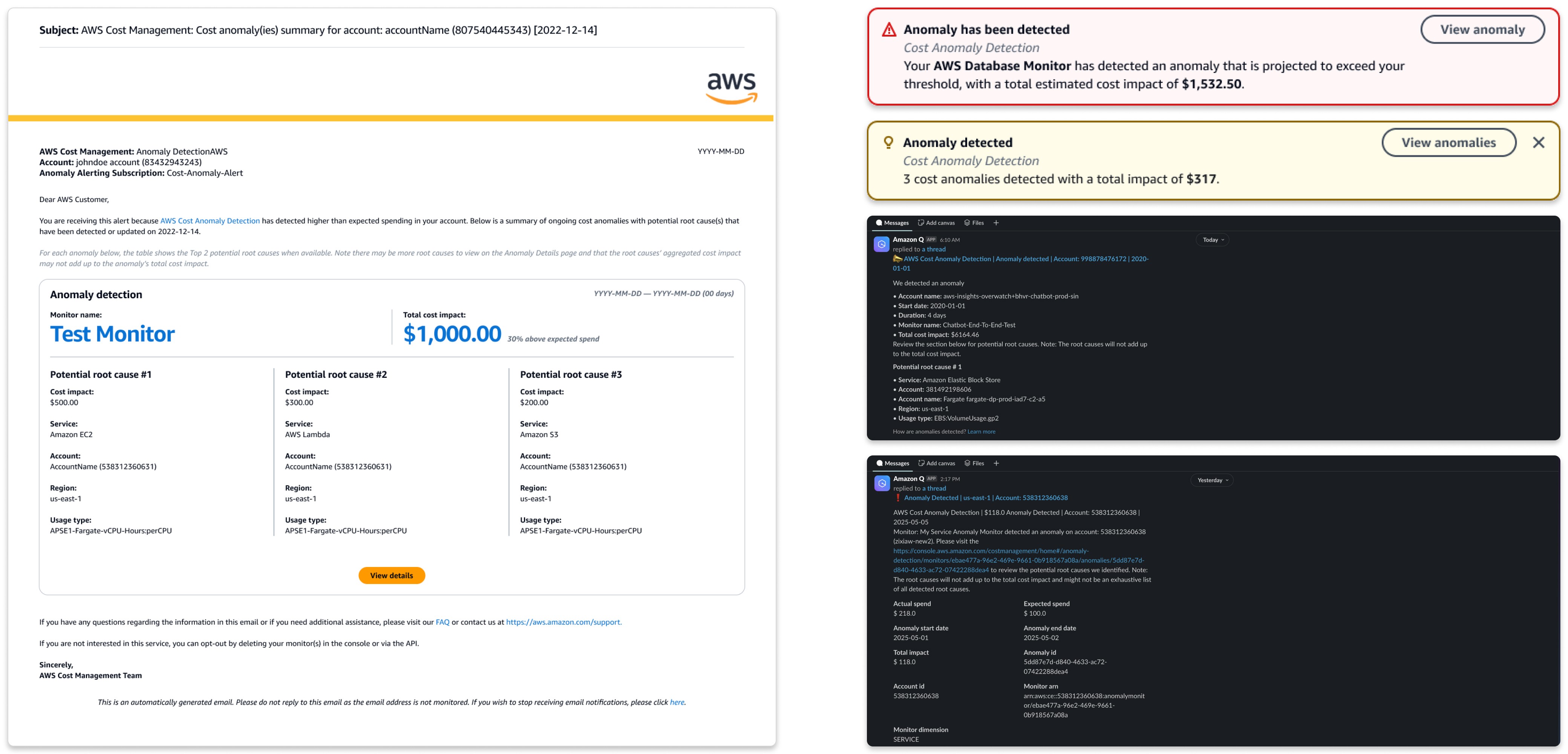
Once a cost monitor and alert subscription are set up, the Cloud Cost Monitor begins working behind the scenes—automatically detecting anomalies within 24 hours and notifying users when thresholds are met. To ensure these alerts are actionable, I designed notifications to include clear, user-friendly explanations along with key contributing factors such as service, account, region, and usage type. This allows users to quickly pinpoint the root cause of cost anomalies without unnecessary investigation. Users can customize their alerting preferences by setting a minimum dollar threshold, such as only receiving alerts for anomalies over $1,000, while the system continuously adapts and refines anomaly detection without requiring manual configuration. This streamlined notification experience has helped customers like MLC Life Insurance and Helix reduce time spent on troubleshooting, avoid misdirected efforts, and take faster, more informed action to control cloud costs.
Once a cost monitor and alert subscription are set up, the Cloud Cost Monitor begins working behind the scenes—automatically detecting anomalies within 24 hours and notifying users when thresholds are met. To ensure these alerts are actionable, I designed notifications to include clear, user-friendly explanations along with key contributing factors such as service, account, region, and usage type. This allows users to quickly pinpoint the root cause of cost anomalies without unnecessary investigation. Users can customize their alerting preferences by setting a minimum dollar threshold, such as only receiving alerts for anomalies over $1,000, while the system continuously adapts and refines anomaly detection without requiring manual configuration. This streamlined notification experience has helped customers like MLC Life Insurance and Helix reduce time spent on troubleshooting, avoid misdirected efforts, and take faster, more informed action to control cloud costs.
Once a cost monitor and alert subscription are set up, the Cloud Cost Monitor begins working behind the scenes—automatically detecting anomalies within 24 hours and notifying users when thresholds are met. To ensure these alerts are actionable, I designed notifications to include clear, user-friendly explanations along with key contributing factors such as service, account, region, and usage type. This allows users to quickly pinpoint the root cause of cost anomalies without unnecessary investigation. Users can customize their alerting preferences by setting a minimum dollar threshold, such as only receiving alerts for anomalies over $1,000, while the system continuously adapts and refines anomaly detection without requiring manual configuration. This streamlined notification experience has helped customers like MLC Life Insurance and Helix reduce time spent on troubleshooting, avoid misdirected efforts, and take faster, more informed action to control cloud costs.
insights & root causes.
insights & root causes.
insights & root causes.
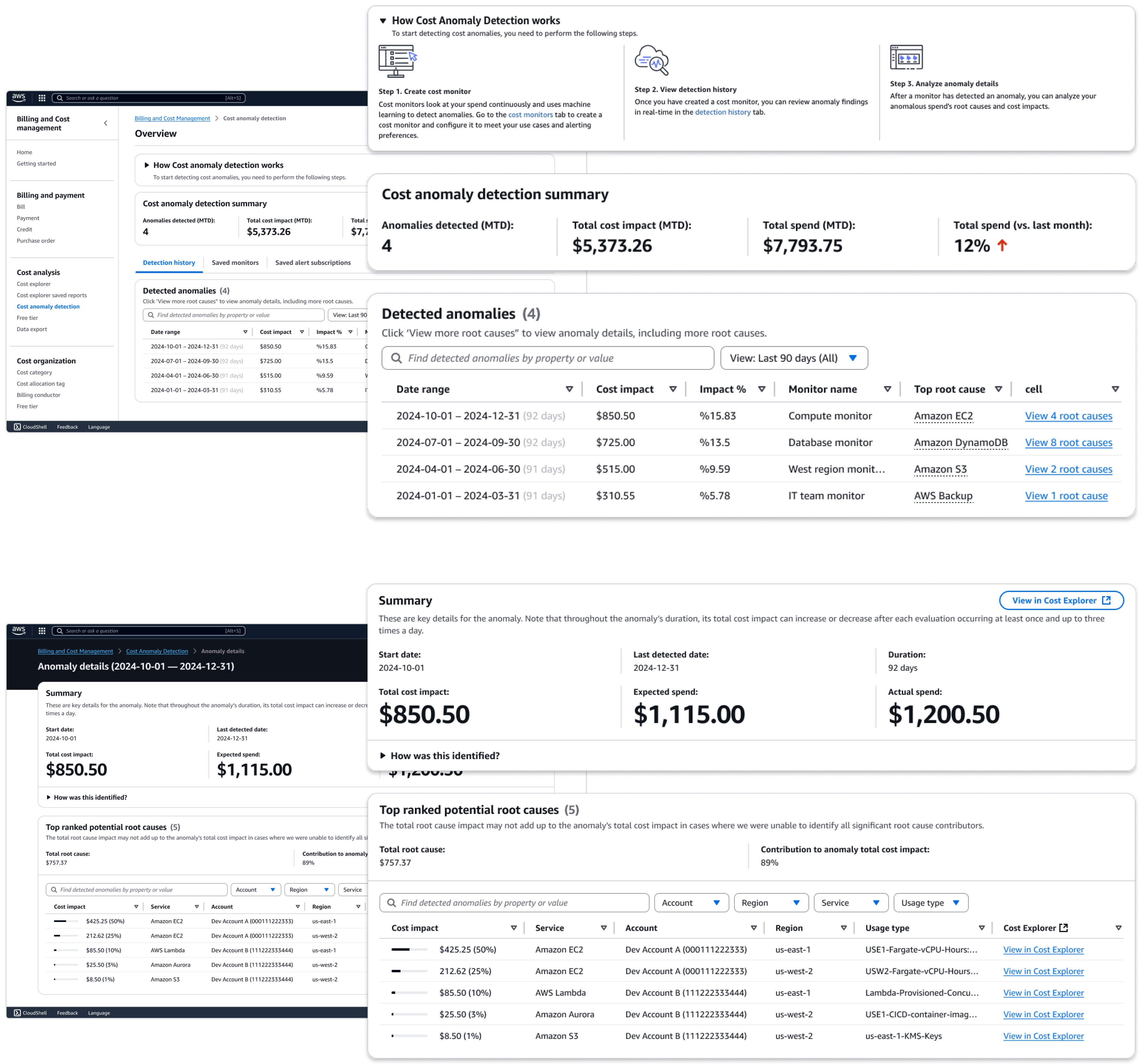
With the root cause analysis in AWS Cost Anomaly Detection, users are now equipped with deeper, more granular insights into the specific drivers behind unexpected cloud spend. The system analyzes and ranks up to 10 root causes based on cost impact, highlighting critical combinations of services, linked accounts, regions, and usage types that contribute to anomalies. These insights are vital for taking swift, targeted action to control costs before they escalate further.
As a UX designer, my role was to translate this powerful backend capability into a front-end experience that delivers clarity, confidence, and control. Cost data can be overwhelming and technical by nature, so I focused on creating intuitive data visualizations, prioritizing information architecture, and crafting interactions that guide users effortlessly from detection to diagnosis. I worked closely with product managers and engineers to ensure that the interface not only surfaces the top root causes but does so in a way that feels approachable and immediately useful.
One of my core design goals was to reduce cognitive load—users shouldn’t have to piece together fragmented data to understand what’s happening. Instead, I designed contextual summaries, cost impact indicators, and drill-down paths that provide a clear narrative: what anomaly occurred, why it happened, and what to do next. This level of clarity turns complex cost analysis into actionable insight, enabling users to respond with precision. In the world of cloud cost management, where every dollar counts, effective UX isn’t just helpful—it’s essential.
With the root cause analysis in AWS Cost Anomaly Detection, users are now equipped with deeper, more granular insights into the specific drivers behind unexpected cloud spend. The system analyzes and ranks up to 10 root causes based on cost impact, highlighting critical combinations of services, linked accounts, regions, and usage types that contribute to anomalies. These insights are vital for taking swift, targeted action to control costs before they escalate further.
As a UX designer, my role was to translate this powerful backend capability into a front-end experience that delivers clarity, confidence, and control. Cost data can be overwhelming and technical by nature, so I focused on creating intuitive data visualizations, prioritizing information architecture, and crafting interactions that guide users effortlessly from detection to diagnosis. I worked closely with product managers and engineers to ensure that the interface not only surfaces the top root causes but does so in a way that feels approachable and immediately useful.
One of my core design goals was to reduce cognitive load—users shouldn’t have to piece together fragmented data to understand what’s happening. Instead, I designed contextual summaries, cost impact indicators, and drill-down paths that provide a clear narrative: what anomaly occurred, why it happened, and what to do next. This level of clarity turns complex cost analysis into actionable insight, enabling users to respond with precision. In the world of cloud cost management, where every dollar counts, effective UX isn’t just helpful—it’s essential.
With the root cause analysis in AWS Cost Anomaly Detection, users are now equipped with deeper, more granular insights into the specific drivers behind unexpected cloud spend. The system analyzes and ranks up to 10 root causes based on cost impact, highlighting critical combinations of services, linked accounts, regions, and usage types that contribute to anomalies. These insights are vital for taking swift, targeted action to control costs before they escalate further.
As a UX designer, my role was to translate this powerful backend capability into a front-end experience that delivers clarity, confidence, and control. Cost data can be overwhelming and technical by nature, so I focused on creating intuitive data visualizations, prioritizing information architecture, and crafting interactions that guide users effortlessly from detection to diagnosis. I worked closely with product managers and engineers to ensure that the interface not only surfaces the top root causes but does so in a way that feels approachable and immediately useful.
One of my core design goals was to reduce cognitive load—users shouldn’t have to piece together fragmented data to understand what’s happening. Instead, I designed contextual summaries, cost impact indicators, and drill-down paths that provide a clear narrative: what anomaly occurred, why it happened, and what to do next. This level of clarity turns complex cost analysis into actionable insight, enabling users to respond with precision. In the world of cloud cost management, where every dollar counts, effective UX isn’t just helpful—it’s essential.

concerns & opportunities.
concerns & opportunities.
concerns & opportunities.
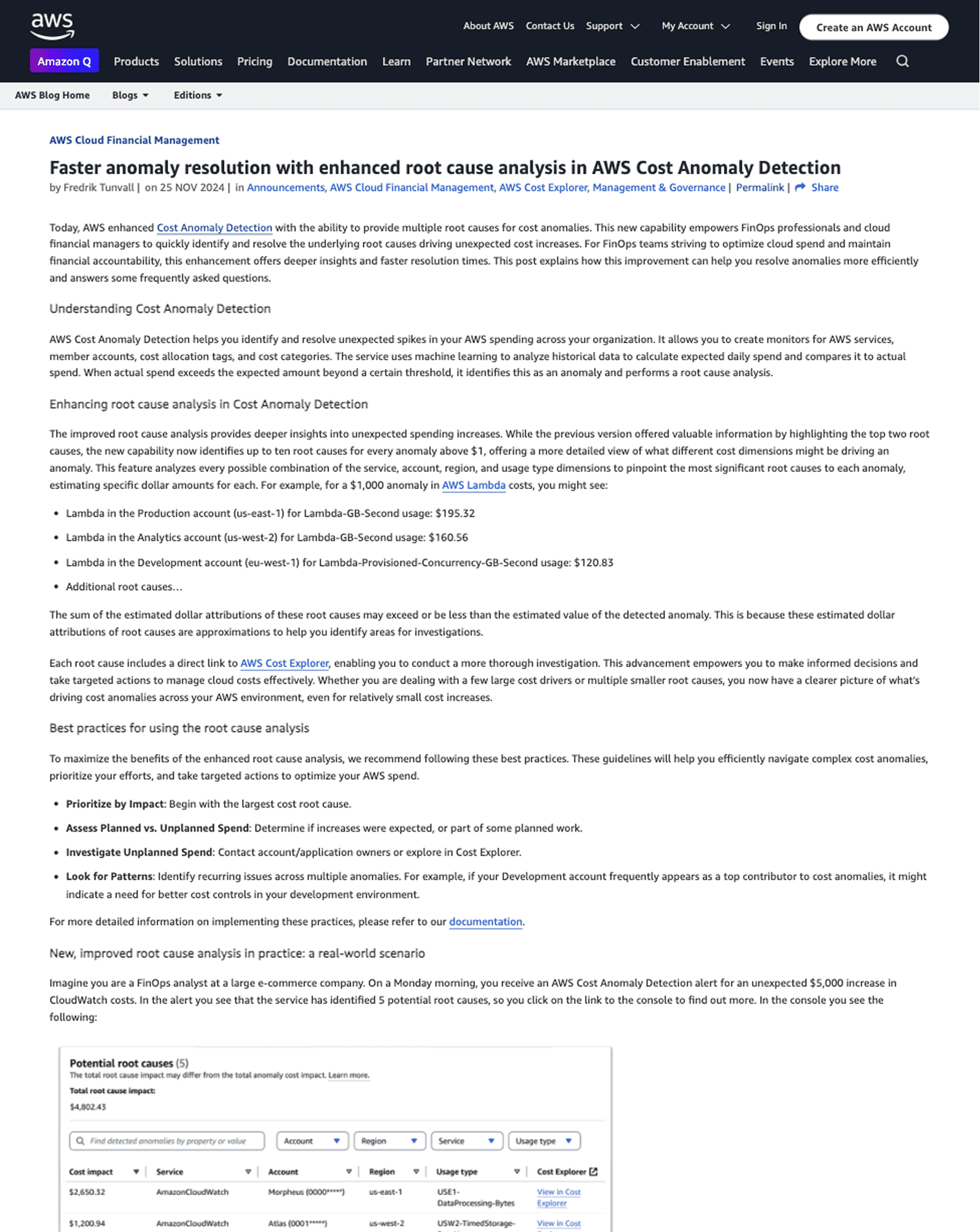
One of my key concerns with the Cloud Cost Monitoring experience was the speed and reliability of user alert notifications. To tackle this, I initiated a retrospective project focused on transforming these pain points into opportunities. I led the Fast Cost Anomaly Detection initiative, which successfully cut detection time from 24 hours to just two. By working closely with Data Scientists and Software Engineers, we also improved the machine learning models, boosting root cause accuracy and enabling identification of the top 10 likely causes.
Looking ahead, I saw an opportunity to further enhance the user experience by partnering with the Cloud Cost Optimization team and integrating AI capabilities. This would not only alert users to unusual cost spikes but also provide clear, actionable recommendations to help them optimize usage and maximize savings.
One of my key concerns with the Cloud Cost Monitoring experience was the speed and reliability of user alert notifications. To tackle this, I initiated a retrospective project focused on transforming these pain points into opportunities. I led the Fast Cost Anomaly Detection initiative, which successfully cut detection time from 24 hours to just two. By working closely with Data Scientists and Software Engineers, we also improved the machine learning models, boosting root cause accuracy and enabling identification of the top 10 likely causes.
Looking ahead, I saw an opportunity to further enhance the user experience by partnering with the Cloud Cost Optimization team and integrating AI capabilities. This would not only alert users to unusual cost spikes but also provide clear, actionable recommendations to help them optimize usage and maximize savings.
One of my key concerns with the Cloud Cost Monitoring experience was the speed and reliability of user alert notifications. To tackle this, I initiated a retrospective project focused on transforming these pain points into opportunities. I led the Fast Cost Anomaly Detection initiative, which successfully cut detection time from 24 hours to just two. By working closely with Data Scientists and Software Engineers, we also improved the machine learning models, boosting root cause accuracy and enabling identification of the top 10 likely causes.
Looking ahead, I saw an opportunity to further enhance the user experience by partnering with the Cloud Cost Optimization team and integrating AI capabilities. This would not only alert users to unusual cost spikes but also provide clear, actionable recommendations to help them optimize usage and maximize savings.

customer feedback.
customer feedback.
customer feedback.
Customers consistently highlight the value of Cost Anomaly Detection in helping them catch unexpected spikes and irregularities in cloud spending before they escalate. They appreciate the speed and accuracy of the alerts, the ability to proactively prevent budget overruns, and the machine learning capabilities that power the feature. Through thoughtful UX design, I focused on making these insights accessible, actionable, and easy to understand—empowering users to respond quickly, optimize their usage, and maintain better control over their cloud budgets. This design approach directly contributed to improved decision-making and greater confidence in managing cloud costs.
Customers consistently highlight the value of Cost Anomaly Detection in helping them catch unexpected spikes and irregularities in cloud spending before they escalate. They appreciate the speed and accuracy of the alerts, the ability to proactively prevent budget overruns, and the machine learning capabilities that power the feature. Through thoughtful UX design, I focused on making these insights accessible, actionable, and easy to understand—empowering users to respond quickly, optimize their usage, and maintain better control over their cloud budgets. This design approach directly contributed to improved decision-making and greater confidence in managing cloud costs.
Customers consistently highlight the value of Cost Anomaly Detection in helping them catch unexpected spikes and irregularities in cloud spending before they escalate. They appreciate the speed and accuracy of the alerts, the ability to proactively prevent budget overruns, and the machine learning capabilities that power the feature. Through thoughtful UX design, I focused on making these insights accessible, actionable, and easy to understand—empowering users to respond quickly, optimize their usage, and maintain better control over their cloud budgets. This design approach directly contributed to improved decision-making and greater confidence in managing cloud costs.

“Cost Anomaly Detection helps businesses quickly identify unexpected spikes or unusual patterns in their cloud spending, which might otherwise go unnoticed. This early detection allows teams to respond proactively, preventing budget overruns and minimizing financial waste.”
Juliana - Senior FinOps Specialist
–––––
“The best way to save money on your bill, something we see every day is to avoid the charge, right? Avoid those extra charges. And the way you can do that is to know of an anomaly in advance. So, one of the best parts of this feature. I can't believe it, we've made it nearly five minutes into this conversation without calling out the most impressive part of Anomaly Detection is the fact that it's all ML-powered.”
Pete - Lastweekinaws.com
“Cost Anomaly Detection helps businesses quickly identify unexpected spikes or unusual patterns in their cloud spending, which might otherwise go unnoticed. This early detection allows teams to respond proactively, preventing budget overruns and minimizing financial waste.”
Juliana - Senior FinOps Specialist
–––––
“The best way to save money on your bill, something we see every day is to avoid the charge, right? Avoid those extra charges. And the way you can do that is to know of an anomaly in advance. So, one of the best parts of this feature. I can't believe it, we've made it nearly five minutes into this conversation without calling out the most impressive part of Anomaly Detection is the fact that it's all ML-powered.”
Pete - Lastweekinaws.com
“Cost Anomaly Detection helps businesses quickly identify unexpected spikes or unusual patterns in their cloud spending, which might otherwise go unnoticed. This early detection allows teams to respond proactively, preventing budget overruns and minimizing financial waste.”
Juliana - Senior FinOps Specialist
–––––
“The best way to save money on your bill, something we see every day is to avoid the charge, right? Avoid those extra charges. And the way you can do that is to know of an anomaly in advance. So, one of the best parts of this feature. I can't believe it, we've made it nearly five minutes into this conversation without calling out the most impressive part of Anomaly Detection is the fact that it's all ML-powered.”
Pete - Lastweekinaws.com