YEAR:
2025

Project overview.
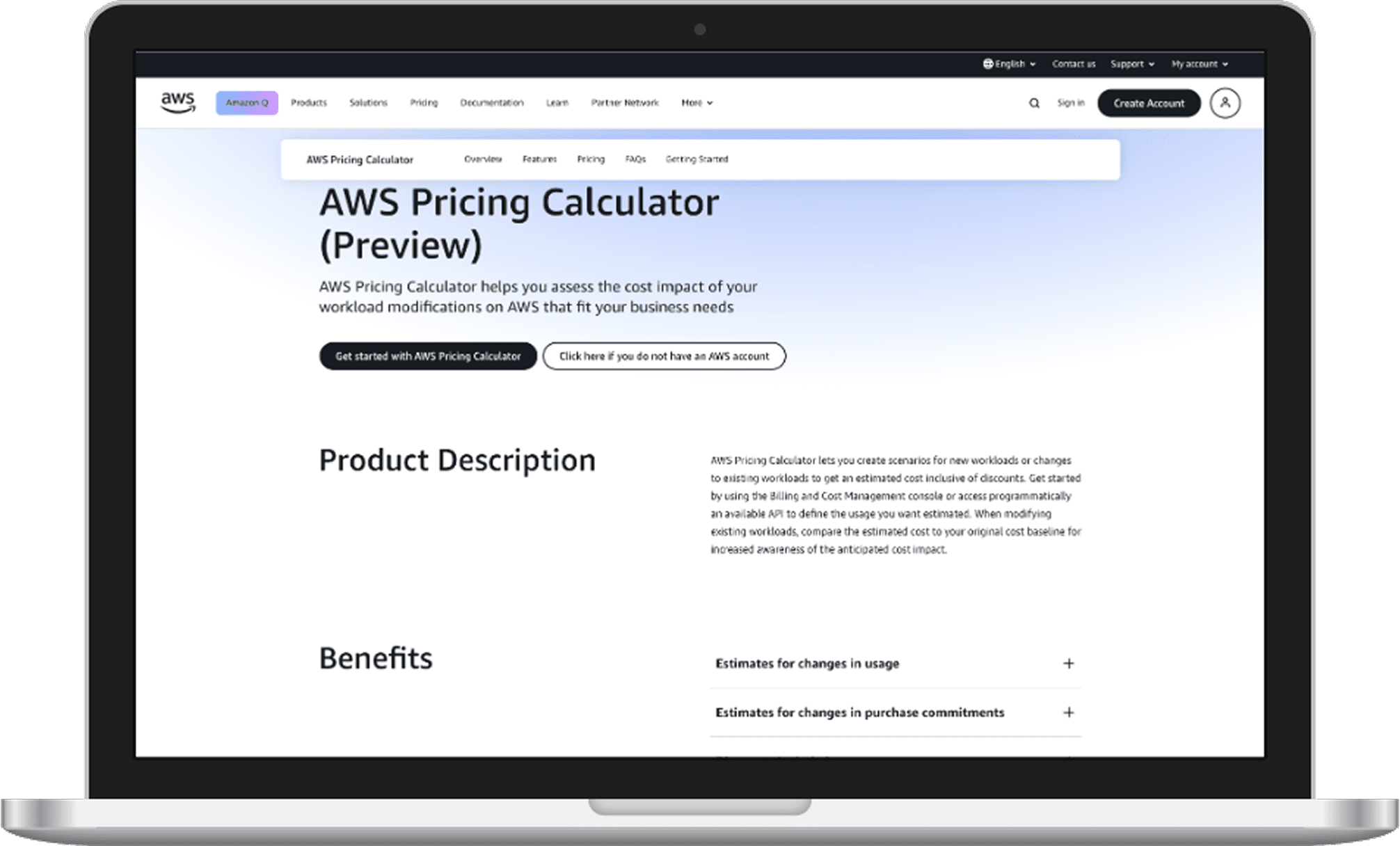
As AWS customers increasingly prioritize cost optimization to justify cloud migrations and modernizations, they face significant friction due to the limitations of traditional pricing tools. Previously, the public pricing calculator relied on generic on-demand rates, failing to account for a customer’s personalized discounts, existing commitments like Savings Plans, or actual usage patterns. This lack of precision often resulted in inflated estimates, leading to stalled IT projects, budget overruns, or a reliance on expensive third-party and home-grown workarounds. To modernize with confidence, customers require a streamlined solution that provides accurate, personalized cost projections to secure budgets and justify architectural changes.
pain point.
“I’m constantly explaining to finance why the forecasted cost is higher than what we actually pay—it creates confusion and slows down approvals.”
“It’s frustrating that we have to resort to third-party tools just to get a decent estimate—we shouldn’t have to pay extra for that.”
“The current tool doesn’t help us model cost savings from using newer instances or relocating workloads to cheaper regions—it’s a missed opportunity.”
“We can’t make confident cloud investment decisions because the pricing calculator doesn’t reflect our actual discounts or usage patterns.”
“The lack of personalized pricing in the calculator creates uncertainty, and that uncertainty kills momentum for innovation and modernization.”
Phase 1
Enters AWS Billing & Cost Management

Phase 2
Create Cloud Cost Estimate

Phase 3
Import Cloud Usage

Phase 4
Model & Modify Usage

Phase 5
Analyze Estimate

Phase 6
Optimize Cloud Spending

ux requirements.
Creating the Cloud Cost Monitor experience centered around empowering users to effectively track and manage their cloud spending with minimal friction. The design process prioritized clarity and usability, simplifying the setup into intuitive, step-by-step flows that guide users through setting budgets, defining thresholds, and selecting key dimensions such as services, accounts, tags, and cost categories. Recognizing the limited attention users can give, the interface was streamlined to reduce cognitive load by chunking information, surfacing only the most relevant insights, and ensuring responsive interactions. This approach enabled users to quickly create cost monitors, receive timely alerts, and confidently manage their cloud expenses without being overwhelmed.


“I’m constantly explaining to finance why the forecasted cost is higher than what we actually pay—it creates confusion and slows down approvals.”
“It’s frustrating that we have to resort to third-party tools just to get a decent estimate—we shouldn’t have to pay extra for that.”
“The current tool doesn’t help us model cost savings from using newer instances or relocating workloads to cheaper regions—it’s a missed opportunity.”
“We can’t make confident cloud investment decisions because the pricing calculator doesn’t reflect our actual discounts or usage patterns.”
“The lack of personalized pricing in the calculator creates uncertainty, and that uncertainty kills momentum for innovation and modernization.”
testimonial.
The STONE MIND project is a stunning, textured centerpiece in our portfolio, with every detail of the 'stone head' meticulously crafted.

Cloud bill